How to Find Leaks What Do Water Leaks Sound Like?

Leaks in underground, pressurized pipes can produce several distinct noises:

  • “Hiss” or “whoosh” — from pipe vibration and pressure drop at the leak orifice

  • “Splashing” / “babbling brook” — from water flowing through the soil around the pipe

  • Rapid “beating” or “thumping” — from spray striking the walls of the soil cavity

  • Small “clinking” — from stones or pebbles bouncing against the pipe

Of these, the hiss/whoosh—often heard as a steady static—is the only sound that’s consistently present when line pressure is 30 psi or higher. The other sounds may or may not occur and are usually quieter. Therefore, when deciding “Is there a leak?”, we primarily listen for the hiss/whoosh.

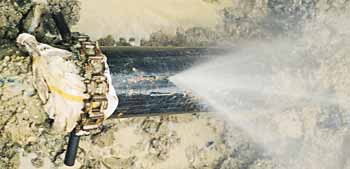
Small leak on cast cast-iron water main
What Factors Affect Leak Sounds?

The loudness and frequency range of leak noise—both along the pipe and up to the surface—depend on:

  • Water pressure in the pipe: Higher pressure generally produces louder leaks (up to a limit).

  • Pipe material & diameter: Different materials (metal, plastic) and sizes change how sound is generated and carried.

  • Soil type & compaction: Dense or compacted soils transmit sound differently than loose or sandy soils.

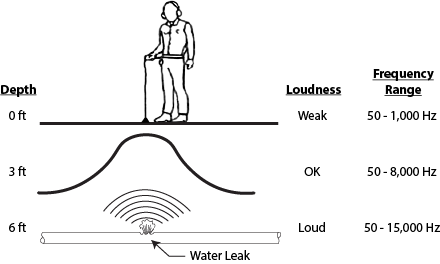
  • Depth of cover: Deeper pipes lose more sound before it reaches the surface.

  • Surface cover (grass, loose soil, asphalt, concrete, etc.): Hard surfaces can mask or filter certain sounds; softer covers may dampen them.

Rule of thumb: Leak sound intensity increases with internal water pressure until it reaches a practical ceiling, after which additional pressure yields little extra loudness.
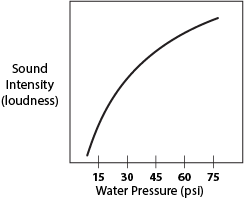
Loudness vs. Water pressure
How Site Conditions Shape Leak Sounds

Pipe material

  • Metal (iron mains, copper services, steel): Carry louder, higher-frequency leak noise.

  • PVC / asbestos-cement: Dampen and shift leak noise toward lower frequencies.
    Knowing the material helps you set expectations for what you’ll hear.

Pipe diameter

  • Large diameters (PVC, concrete, steel, iron): Transmit much less leak noise and favor lower frequencies.

  • Small diameters: Carry stronger, higher-frequency signals.

Soil type & compaction

  • Loose/sandy or freshly backfilled soil; water-saturated ground (bogs/swamps): Poor transmission—sounds fade quickly.

  • Hard, well-compacted soil: Best transmission to the surface.

Depth of cover

  • Shallow lines (≈3–4 ft): Typically audible at the surface.

  • Deeper lines (≈7–8 ft): Only large leaks with good pressure produce enough noise to reach the surface.

Surface cover

  • Hard surfaces (asphalt, concrete slabs): Can resonate with leak sounds; you may hear them 5–10 ft or more to either side of the pipe.

  • Grass or loose dirt: Offer little resonance and make firm sensor contact harder, reducing what you can hear.


How Do Leak Sounds Travel Along Pipes?

Leak noise travels much farther on metal pipes (iron mains, copper, steel) than on asbestos-cement (AC) or PVC. Metal tends to carry a stronger, higher-frequency “hiss/whoosh,” while AC and PVC dampen and shorten the signal. Pipe diameter also matters: as diameter increases, the noise typically doesn’t travel as far.

Approximate propagation of “hiss/whoosh” (2 GPM leak at 60 PSI):

Pipe material & diameterTypical distance sound travels
Cast iron – 6 in600–1,000 ft
Cast iron – 12 in400–800 ft
Cast iron – 24 in200–400 ft
AC – 6 in400–800 ft
AC – 12 in300–500 ft
AC – 24 in100–300 ft
PVC – 6 in200–300 ft
PVC – 12 in100–200 ft
PVC – 24 in50–100 ft

Why this matters: Knowing the pipe material and diameter helps you predict how far leak noise can carry along the line—and where it’s realistic to place sensors for pinpointing the leak.

Soil absorbs the high frequencies to a greater degree than the low frequencies. For a leak in a pipe 6 ft deep, the “Hiss” or the “Whoosh” sound is weak and “muted,” i.e. only the lower frequencies are heard. For a leak in a pipe 3 ft deep, the sound is louder and slightly higher in frequency.

Surveying

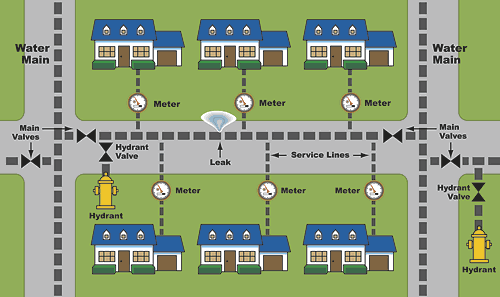
“Surveying” is the term applied to listening for water leaks when there is no obvious evidence, like water flowing on the street. Every hydrant, valve, and service line is a possible location to hear the sounds of water leaks:

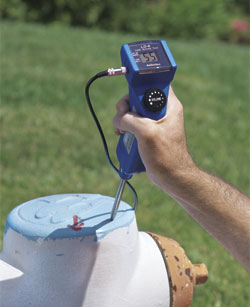
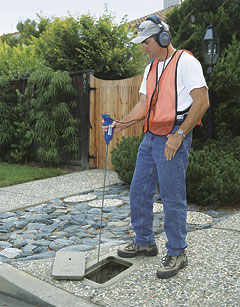
Since the sounds travel on the pipe walls better than through the soil, always listen at the hydrants, valves, and meters first. As you get closer to the leak, the sound gets louder. Finally, decide which two of these locations are the loudest. Now you are ready for “Water Leak Pinpointing.”

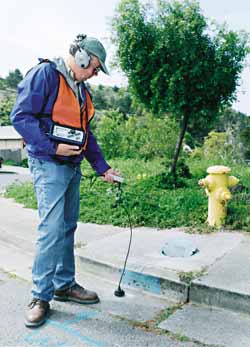
Surveying at a Hydrant and a Service Line:
Pinpointing

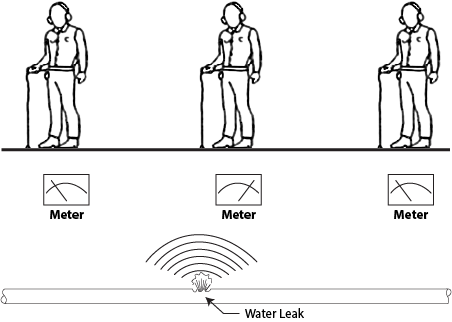
Water leak pinpointing is the process of finding the exact break in the line. In acoustic leak detection, the pinpoint is typically the location where the leak noise is strongest (peak sound level) when measured directly over the pipe. Technicians confirm by taking short step readings and checking that the sound drops off on both sides of the peak.

To find this spot, the listener must carefully mark the location of the water line on the street after locating it exactly with a pipe and cable locator. Usually, the piping between the valve or hydrant with the loudest sound and the valve or hydrant with the second loudest sound is the section of the line that needs to be marked. The section must be accurately located and marked on the street in order for the listener to consistently listen directly over the pipe.

The listener moves the ground microphone 3 to 4 feet each time in the direction of the water line, listening, and moving closer to the water leak. While the listener is moving, he does not adjust the volume control, since the volume control must be held constant in order to make accurate comparisons. When the listener is very close to the leak, it may be impossible to decide based upon the user’s hearing alone whether the leak is in one spot or in a spot 3 to 4 feet away. When this occurs, the listener must study the visible display (meter) to see if the signal is slightly stronger at one location than at another location.

Leak Pinpoint Over a Hydrant Line

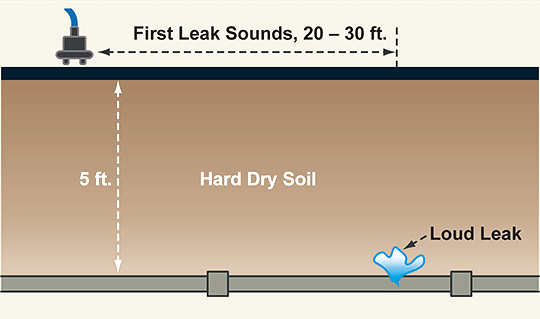
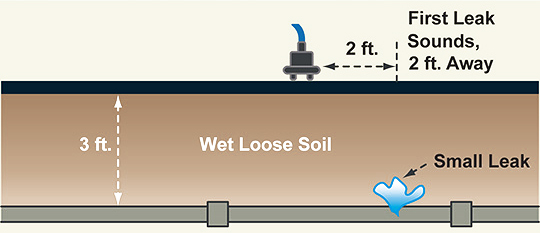
The loudness of a leak heard on an asphalt street or a concrete slab depends upon the size of the leak, water pressure, and depth of the pipe. Hard, dry materials like asphalt, concrete, rock, and compacted soil transmit sounds better than wet clay, sand, or loose soil. The sounds travel further on iron and steel pipes than on PVC pipes or Poly pipes.

Example 1: Iron Pipe, 75 Psi, 10 GPM Leak, 5 ft. Depth

Example 2: PVC Pipe, 50 Psi, 1 GPM Leak, 3 ft. Depth